The signs, in the order they usually appear
A house on stumps tells you it is moving long before anyone looks underneath. The signs show up in a rough order, because the stump drops first, the bearer follows, the floor tilts, and then the walls that stand on the floor go out of square.
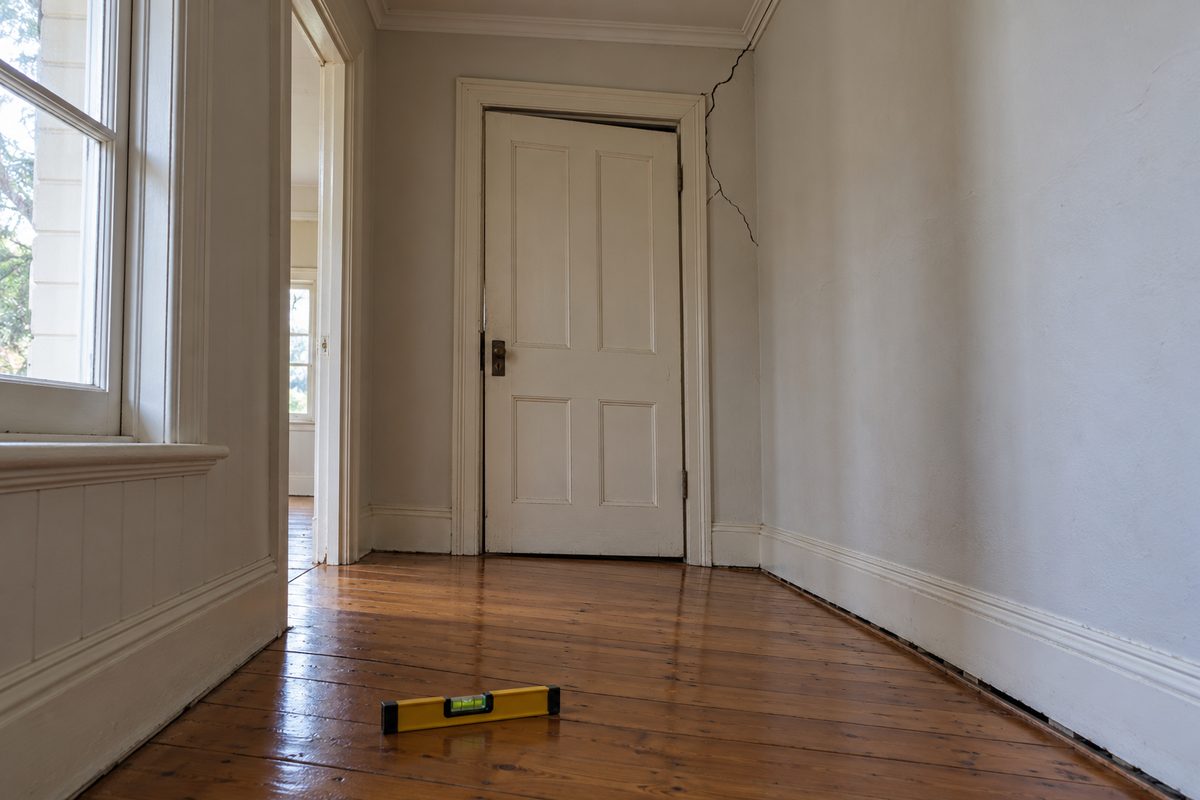
- A door that needs lifting. The first thing most people notice. A door that shut cleanly in summer has to be lifted to latch by August. The frame has gone out of square because one side of the floor has dropped.
- A floor that slopes to one wall. A marble put down in the hallway rolls to the same wall every time. In a Drouin or Warragul weatherboard it usually runs toward the kitchen and bathroom side, where the wet areas and the worst drainage are.
- Cracks from the corners of frames. Diagonal cracks in the plaster from the top corner of a door or window up toward the cornice. On reactive ground they open in late summer and close after the winter rain; on a house with a rotten stump they open and stay open.
- A gap under the skirting. The skirting board is fixed to the wall and stays put while the floor drops away from it. Daylight under a skirting is a stump or a bearer, not a carpenter.
- A bouncy or dipped section of floor. A floor that gives underfoot between two firm points is a bearer or a joist that has rotted, not a stump.
- Cracks in the brickwork outside. Stepped cracks following the mortar joints on a brick veneer. If the house is on stumps, a stump has dropped under that corner. If it is on a slab or a strip footing, the footing has moved and that is underpinning.
- A chimney leaning away from the house. Chimney bases sit on their own heavy footings. When they drop at a different rate from the stumps around them, a gap opens between the chimney and the wall.
- A gap between the floor and the bottom of the wall lining. Visible in a cupboard or behind the fridge, where nobody has patched it.
What it looks like under the house
From inside, the signs say the house has moved. From underneath, they say why. A subfloor inspection with a torch, a long level and a moisture meter takes an hour and settles whether the job is restumping, relevelling, bearers, or drainage.
| Under the house | What it means |
|---|---|
| Stump soft or hollow at the ground line when probed | Rot. The stump is replaced. In this district it is the common finding. |
| Stump leaning, bearer no longer sitting square on it | The ground has moved or the stump was never deep enough. Replace, deeper. |
| Tide marks on the stumps at the same height | Water pools under the house in winter. Drainage before, or with, the stumps. |
| Mud tunnels up a stump, galleries in the timber | Termites. Whole of Baw Baw Shire is deemed termite prone. Pest controller, then replacement. |
| Stack of timber, brick or slate packing between stump and bearer | The house has been relevelled before, cheaply. Packing over 25 mm is a building report finding. |
| Bearer soft at the stump, floor dipped above | Rotted bearer. Replaced while the house is up. |
| Stumps and bearers sound, floor still out of level | Settlement. Relevel on the existing stumps. |
| Brick piers cracked, strip footing exposed | Footings on clay. Underpinning and an engineer, not stumps. |
Why West Gippsland houses show these signs
Three local reasons, and most houses have at least two.
Water. The Bureau of Meteorology's Ellinbank record averages 1,100 mm a year, and the subfloor of an old house does not dry out between May and October. Timber stumps rot from the ground line down. The Moe River flats around Darnum, Trafalgar and Yarragon were a swamp until the 1880s and VICSES says they still flood frequently, so a house there has stumps standing in wet ground for part of every year.
Soil. The red ferrosols on the Warragul and Thorpdale hills are deep and acidic, hard on untreated timber. Where the lower ground is reactive clay it swells wet and shrinks dry, which is why cracks on some houses open in March and close in September.
Age. The railway reached Warragul in 1878 and the towns grew along it, then again after the war. The shire's community profile says growth took place in Drouin, Trafalgar and Warragul in the post-war years. A weatherboard from either period is on stumps that have seen sixty to a hundred and forty winters.
What a pre-purchase inspector looks for
A building inspector in Baw Baw Shire will probe stumps at the ground line, note packing over about 25 mm, look for moisture staining, tide marks and fungus, and check the bearers at the wet-area corner. A pest inspector follows termite tunnels up the stumps. If either report names the stumps, the buying guide covers what to do with it before settlement.
What these signs cannot tell you
They cannot tell you how many stumps have gone, which is what the price depends on. They cannot tell you whether the bearers above the stumps are sound. They cannot distinguish, from inside, a dropped stump from a dropped footing on a brick veneer. And they cannot tell you whether the cause is still active: a shower that has been leaking into the subfloor for ten years will rot the new timber as happily as the old. All of that is the inspection, and it is an hour under the house with a torch.
Check the current rules before you rely on this
This page describes how subfloor problems show up in homes in Baw Baw Shire and what they usually mean. It describes the rules in general terms as they stood in October 2026. Standards, forms, thresholds and fines change.
The authoritative sources are Bureau of Meteorology climate statistics, Ellinbank Dairy Research Institute, VICSES Moe River Flats local flood guide, Baw Baw Shire Council property information and building record requests and Baw Baw Shire community profile, about the area (.id). Where anything here differs from those sources, they are right and we are not.
We are not building surveyors, engineers, planners or lawyers. For what applies to your house, ask a registered building surveyor or ring Baw Baw Shire Council on 03 5624 2411.
Accurate at the time of writing, October 2026. Always check the source before relying on it.